Climb Mount Toubkal 2026: Cost, Difficulty, Guide Rules, Routes & Best Time
Everything to plan a Toubkal trek from Marrakech: real costs from 1,300 MAD, whether a guide is required, how hard it is, 2 vs 3 day routes, refuge prices and when to go.
Mount Toubkal is the highest peak in North Africa at 4,167 meters (13,671 feet), and the trail starts in a village about two hours from Marrakech. That mix of a real high mountain and an easy transfer is why it shows up in almost every Morocco itinerary, and why the information about it is such a mess.
Search for the price and you will find a guide at 400 MAD a day on one site and 1,200 on another, a package at 99 euros and another at 500. Some pages say you need a guide by law, others say it is optional. Some call it an easy hike and others a serious mountain. They are mostly describing different seasons, group sizes and routes.
I read through the main pages that rank for Toubkal, from tour operators and hiking sites to the guides' office in Imlil, and put the useful parts in one place: costs, rules, difficulty, routes, altitude, gear and timing. Where sources disagree, I say so. Prices are 2026 ranges at about 10 MAD to the US dollar. Last checked November 2026.
Mount Toubkal at a glance
If you only need the key facts, here they are. The rest of the guide explains each one.
- Height: 4,167 m (13,671 ft), the highest point in North Africa, in Toubkal National Park in the High Atlas.
- Starting point: Imlil (1,740 m), about 60 to 75 km (sources differ) and 1.5 to 2 hours from Marrakech.
- Standard trip: 2 days, with a night in the mountain refuge at 3,207 m.
- Better trip: 3 days, with an extra night for acclimatization, which gets more people to the top.
- Difficulty: a strenuous trek in summer with no technical climbing, but a real altitude challenge. In winter it becomes mountaineering.
- Guide: treated as mandatory since 2018 to 2019, with passport and guide checks at checkpoints and reportedly a limit of about six hikers per guide.
- Cost: about 1,300 to 2,500 MAD if you organize it yourself, or 130 to 400 euros per person for a package.
- Best time: April to June and September to October. Winter conditions run roughly November to April.
How much does it cost to climb Toubkal?
The standard trek takes two days. What you pay depends mostly on whether you book a package or assemble it yourself, and on how many people share the guide, the mule and the car.
Operator pricing shows this clearly. One local company charges about 125 euros per person in a group of 14 to 17 for the 2 day trek, 220 euros each for two people, and 360 euros for a solo traveler. A 3 day route from another operator runs from about 195 euros per person in a big group to around 300 euros each for a pair and 470 to 520 euros for one person.
- Organizing it yourself, two people sharing a guide and a private car: about 2,400 to 3,600 MAD in total, so roughly 1,200 to 1,800 MAD each.
- Organizing it yourself, solo, by shared taxi: about 1,300 to 2,500 MAD, adding up the guide, refuge, meals and transport below.
- Shared group package, 2 days: about 100 to 200 euros per person.
- Private package for a couple, 2 days: about 250 to 400 euros per person, and 350 to 500 euros for 3 days.
- 3 day Azzaden Valley route: about 180 to 235 euros per person in a group, more for private or solo.
- Winter extras: crampons and an ice axe, about 5 euros a day each to rent in Imlil.
Why prices on other sites don't match
Some pages quote only the guide, some add the refuge and meals, and some include the transfer from Marrakech. Always check what is in a number before you compare it with another one, and ask how the price changes if the group is smaller than advertised.
Is a guide mandatory for Toubkal?
This is where websites disagree the most. A few operator pages say a guide is only recommended. Most recent hiking sources and travelers say it is required, and I'd plan on that.
The rule dates from 2018 and 2019, after two hikers were killed near Imlil in December 2018. Since then a licensed local guide has been needed on the Imlil to Toubkal trail, and reports describe checkpoints on the route where passports and guide ID are checked. Even without the rule, there are good reasons to go with one. The guide handles the refuge booking and the mule, knows the trail, and in winter judges snow and ice.
Only hire a licensed guide
Licensed guides work through the Bureau des Guides, the official guides' office in Imlil, and carry credentials. People who approach you on the road or in the village offering to guide you for less can cause problems at the checkpoints. Book through the bureau or an operator that uses licensed guides, and confirm the details with them before you go.
Rules and checkpoints: what has changed
Toubkal's rules tightened after 2018, and a local operator based in Imlil describes further changes in 2025. These details come from operators and travelers, not from one official notice I could find, so treat them as what to expect and ask your guide to confirm them before you go.
- Checkpoints: reportedly four inspection points on the road and trail up to the mountain, where your passport (or national ID for Moroccans) and your guide are checked. You may be asked how many days you will spend and where you are going.
- Guide required: independent trekking is described as illegal, and every group must be accompanied by a licensed local guide.
- Group size: reportedly about six hikers per guide, so a bigger group needs more than one.
- Weather: from 1 November to the end of March, trips can reportedly be stopped when the forecast is bad, including being turned back at Aremd instead of being allowed up to the refuge.
- Timing: hikers have reportedly been stopped from heading up after about 3 PM, so start early.
- Camping: tents in the park reportedly need a permit from the local authorities.
Check before you go
Rules like these are enforced locally and can change from one season to the next. If you have a package booked, ask your operator to confirm the current rules, and carry your passport on the trail.
Guide, mule and refuge prices
Here is how the individual costs look if you build the trip yourself. Sources vary, so these are ranges, and the guide is the line that moves the most.
- Licensed guide through the Bureau des Guides: about 400 to 600 MAD per day ($40 to $60). One Imlil operator quotes the bureau's official rate as 60 euros (about 600 MAD) a day, or about 1,000 MAD for a 2 day trek, split among the group.
- Guide booked through an operator in advance: about 500 to 800 MAD per day, or 50 to 80 euros.
- Mule with handler, to carry your main bag to the refuge: about 200 to 350 MAD per day.
- Refuge dorm bed: about 150 to 300 MAD per night. One report puts a CAF refuge bunk at about 250 MAD with no blankets, and Les Mouflons at about 350 MAD with dinner and breakfast.
- Refuge meals: about 80 to 200 MAD each, so dinner and breakfast add roughly 160 to 400 MAD.
- Park entrance fee: one source lists about 20 MAD per person. Ask your guide, since other pages don't mention it.
- Tips: guides and mule handlers are tipped separately, see our tipping guide. One local operator suggests starting around 30 euros (about 300 MAD) for the guide on a 2 day trek, with less for the mule handler and cook.
Getting from Marrakech to Imlil
Imlil is the road-end village where every standard Toubkal trek starts. The drive from Marrakech takes about 1.5 to 2 hours, through Asni and up the valley.
The cheapest way is by shared grand taxi, usually in two hops. It works, but expect some waiting and a slower start. Our taxi fares guide explains how shared taxis work and what to ask before you get in.
- Shared grand taxi, Marrakech (Bab er-Rob) to Asni: about 25 to 30 MAD per seat.
- Shared grand taxi, Asni to Imlil: about 15 to 20 MAD per seat.
- Private transfer, one way: about 300 to 600 MAD per vehicle, or 600 to 1,000 MAD return.
- Packages include the transfer, so the price is built in.
Leave Marrakech early
Day one is a 5 to 6 hour climb, so an early start from Marrakech means you reach the refuge in daylight and avoid the worst of the afternoon heat on the lower slopes.
How hard is it to climb Toubkal?
In summer there is no rope work and no technical climbing. The path is rocky but easy to follow, and most reasonably fit people can do it. That does not make it a walk. You gain about 2,400 meters over two days, and you go from roughly 1,700 meters to over 4,000 in about a day and a half.
The main difficulty is the altitude. At the summit the air holds about 60 percent of the oxygen you have at sea level. The second hardest part is the descent, because the loose scree below the summit is hard on knees, which is why trekking poles come up in nearly every trip report.
A good rule of thumb: if you can comfortably hike 15 km with a big climb in a day, you can do Toubkal in summer. Training with long hikes that include elevation gain in the months before makes a real difference. In winter, with snow and ice, the same route needs experience and the right gear.
The 2 day route, step by step
This is the standard trek. Distances and times vary a little between sources, so treat these as typical figures for a fit hiker.
Day one: from Imlil (1,740 m) the trail follows the Mizane Valley through walnut and cherry orchards and past the village of Aremd. About 2 to 2.5 hours in you reach Sidi Chamharouch (about 2,300 m), a white shrine with a few tea stalls, and the last place for refreshments. Above it the path steepens through a rocky gorge to the refuge. Expect about 11 to 13 km, roughly 1,400 to 1,470 meters of climbing, and 5 to 6 hours of walking.
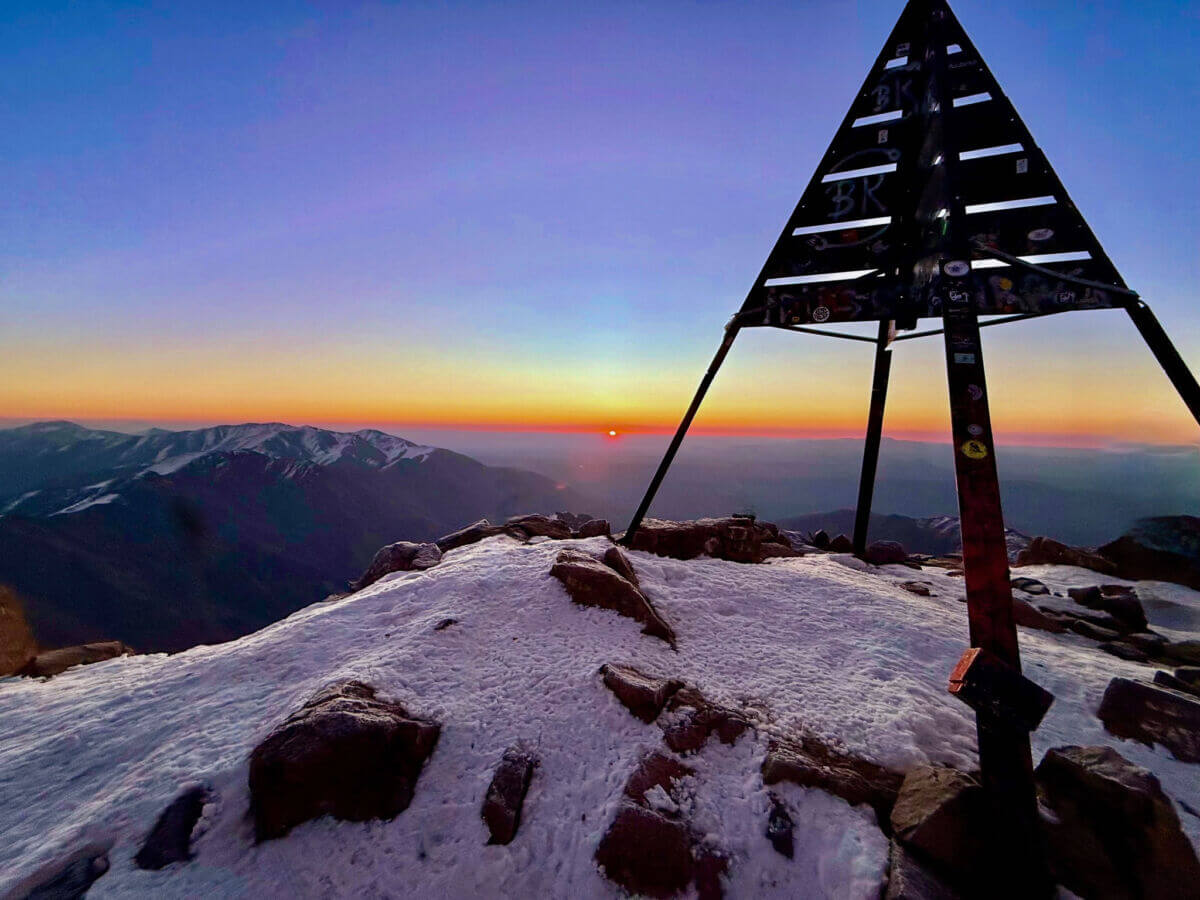
Day two: most groups leave the refuge between 4 and 6 AM. The climb to the summit gains about 960 meters over roughly 3 km, mostly on scree and loose rock, and takes 3 to 4 hours. A metal pyramid marks the top, and on a clear day you see the Atlas ridges and the plains to the north. You then walk down to the refuge (2 to 3 hours) and on to Imlil (another 4 to 5 hours). Altogether, day two is an 8 to 11 hour day.
- Day 1: Imlil to refuge, about 11 to 13 km, +1,400 to 1,470 m, 5 to 6 hours.
- Day 2 up: refuge to summit, about +960 m, 3 to 4 hours.
- Day 2 down: summit to refuge in 2 to 3 hours, then refuge to Imlil in 4 to 5 hours.
- Total distance: about 24 km.
- Some trekkers try the whole thing in one very long day and skip the refuge. I wouldn't, since it is exhausting and the guide arrangements are built around the overnight stay.
2 days or 3: which route should you pick?
The 2 day trek is the cheapest and fastest, and it suits fit hikers with limited time. The catch is that it gives your body very little time to adjust.
A popular alternative is the 3 day route through the Azzaden Valley. You drive to Imlil, cross the Tizi n'Mzik pass (about 2,489 m) to the Berber village of Tamsoult, then climb over the Tizi n'Aguelzim pass (about 3,550 m) to the refuge, and summit on day three. Operators who run both say more people reach the top on the longer route, and you see a quieter valley instead of walking the same path twice.
There are longer options too, including 4 and 5 day treks that combine Berber villages with the summit, and a 3 day trip that adds the neighboring Ouanoukrim peaks. If this is your first time above 4,000 meters, I'd choose three days.
The cheap fix for altitude
Adding one night, either in the Azzaden Valley or a second night at the refuge, is usually the least expensive way to improve your odds of reaching the summit comfortably.
Altitude sickness: what to watch for
At these heights it is common, even for fit people. Typical signs are a headache, nausea, dizziness, poor sleep and unusual tiredness. In trip reports, a few people in a group usually feel some of these, and guides turn the worst affected back down.
The rule is simple. Mild symptoms mean slow down and rest. If symptoms get worse, or you feel confused or very unsteady, you go down, and you don't keep climbing to save the trip. Drink plenty of water, eat even if you're not hungry, and tell your guide how you feel instead of hiding it. This is general information and not medical advice, so talk to a doctor before you go if you have a heart or lung condition.
Refuge options and what a night there is like
On the standard route you sleep at about 3,207 meters. There are two refuges side by side: Les Mouflons, which is larger and busier, and the CAF refuge (the old Neltner hut, built in 1938 and renovated in 1999), which is smaller and more traditional. Both have dorms, hot meals and gear storage, but facilities are basic.
Dorms are shared, nights are cold, and you start early, so earplugs and a warm sleeping bag are worth having. Expect basic comforts: trekkers report cold showers and toilets without paper or soap, and the CAF bunks come without blankets. Both refuges stay open all year. In the busy season, roughly April to October, book ahead or let your guide or operator handle it, while in winter and spring there is usually room on arrival. There are no card machines on the mountain, so carry cash.
When is the best time to climb Toubkal?
The mountain and its refuges are open all year, so the real question is conditions. The summer season runs roughly May to October, when the trails are usually clear of snow. The most comfortable windows are April to June and September to October, with stable weather and no extreme heat. Even in July the summit is cold and windy at dawn.
Winter, roughly November to April, is a different trip. The upper mountain is under snow and ice and you need crampons, an ice axe and the skill to use them. Slopes of 30 to 35 degrees, wind and avalanche risk all come into it, and winter climbers often spend an extra night at the refuge to adjust and practice. In April the valley can feel like spring while the summit is still in winter, so don't judge conditions from Imlil.
For the wider picture of weather and prices across the country, see our best time to visit guide.
Winter is not a beginner hike
You can rent crampons and an ice axe in Imlil, at roughly 5 euros a day each (one operator quotes 400 MAD for two pairs of crampons plus snow protection for three days), but owning the kit is not the same as knowing how to use it. If you have never used them, go in summer or book a guide who offers a proper briefing first.
Package or do it yourself?
Doing it yourself is cheaper if you're comfortable with shared taxis and arranging things in Imlil. A package costs more, but it covers the transfer, the guide, the bed and the meals in one booking, which matters if you only have a couple of days.
Either way, ask a few questions before you pay.
- Is the guide licensed by the Bureau des Guides, and can you see the credentials?
- What exactly does the price include: transfer, refuge bed, meals, mule, park fee, gear rental?
- How many people will be in the group, and does the price change if others drop out?
- In winter, are crampons and an ice axe included, and will the guide show you how to use them?
- What is the cancellation policy if snow or weather stops the trek?
What to pack
You don't need much specialist kit in summer, but the mountain is much colder and windier than Marrakech suggests.
- Broken-in hiking boots. Never new ones.
- Layers: a warm fleece or light down jacket, a waterproof shell, a hat and gloves. Summit mornings are cold.
- Trekking poles, which save your knees on the scree descent.
- A headlamp for the pre-dawn start.
- Sun protection, since the sun is strong at altitude.
- A sleeping bag, or ask whether the refuge supplies blankets.
- Water, snacks and cash in small notes for tips, mules and tea stops.
- Your passport, which is checked at the trail checkpoints.
- In winter: crampons, an ice axe, warm boots that fit crampons, and extra layers.
Staying in Imlil before or after
Imlil has a range of guesthouses and small hotels, and spending a night there before you start is a good way to begin acclimatizing and meet your guide. Rooms are cheap by Moroccan standards, with one traveler reporting about 7 euros for a basic room, though prices vary by season and quality, so check current rates.
The area was hit hard by the September 2023 earthquake. Treks are running normally in 2026, but ask your guide or operator about current conditions and any changes to accommodation.
If you don't want to summit
You don't have to go to the top to enjoy the mountains. A day trip from Marrakech to Imlil and the lower valley, or the Ourika Valley, gives you the scenery without the altitude. See our Ourika Valley day trip prices and the mountain excursion price page for costs.
If you're building a longer trip, Toubkal fits well before or after a few days in Marrakech. Our Morocco itinerary guide shows how to combine it with the desert and the north.
Mistakes first-timers make
These are the ones that show up again and again in trip reports.
- Treating it as a casual hike and skipping fitness preparation.
- Booking the 2 day trek with no spare day, then feeling rough on summit morning.
- Hiring an unlicensed guide in the village because the price was lower.
- Assuming April or early May means no snow near the summit.
- Wearing new boots, or leaving poles behind and paying for it on the descent.
- Comparing prices without checking what is included.
- Arriving at the refuge with no cash.
- Leaving your passport behind in Marrakech. It is checked at the trail checkpoints.
- Starting late. Hikers have reportedly been stopped after about 3 PM, so set off early.
Frequently asked questions
How hard is it to climb Mount Toubkal?
In summer it is a strenuous but non-technical trek. You gain about 2,400 meters over two days and the altitude is the main challenge, so reasonably fit hikers can do it. In winter, with snow and ice, it requires crampons, an ice axe and experience.
How long does it take to climb Toubkal?
The standard trek takes 2 days: 5 to 6 hours from Imlil to the refuge, then 3 to 4 hours to the summit and a further 6 to 8 hours back down to Imlil on day two. A 3 day route gives you an extra night to adjust to the altitude.
Do I need a guide to climb Toubkal?
Plan on it. A licensed local guide has been required on the Imlil to Toubkal trail since 2018 to 2019, and checkpoints reportedly check guide ID and passports. Groups are reportedly limited to about six hikers per guide. A few operator pages still call a guide optional, so confirm with your guide or the Bureau des Guides in Imlil.
How much does it cost to climb Mount Toubkal?
If you organize it yourself, a 2 day trek costs about 1,300 to 2,500 MAD per person, or 1,200 to 1,800 MAD each for two people sharing a guide and a car. Packages run about 100 to 200 euros per person in a group and 250 to 400 euros for a private trip.
What is the best time of year to climb Toubkal?
April to June and September to October are the most comfortable months. The trails are normally snow-free from about May to October, while winter conditions run roughly from November to April.
Can beginners climb Mount Toubkal?
Fit beginners can do it in summer with a guide, but it is a long day at altitude. Train with long hikes, give yourself an acclimatization day if you can, and avoid winter unless you have mountain experience.
Do I need crampons and an ice axe for Toubkal?
Not in summer. From roughly November to April you may need them, and in some years snow lasts into spring. You can rent both in Imlil for about 5 euros a day each, and one operator quotes 400 MAD for two pairs of crampons and snow protection for three days.
Can you climb Toubkal in one day?
Some trekkers attempt it in one very long day from Imlil, but it is exhausting and the standard arrangement is an overnight stay at the refuge. A day trip from Marrakech normally means the lower valley, not the summit.
Is the 2 day or 3 day Toubkal trek better?
The 2 day trek is cheaper and faster for fit hikers. The 3 day route through the Azzaden Valley adds a night and a gentler build-up, and operators report that more people reach the summit on it.
How do I get from Marrakech to Imlil?
Take a shared grand taxi from Bab er-Rob to Asni (25 to 30 MAD per seat) and another from Asni to Imlil (15 to 20 MAD per seat), or arrange a private transfer for about 300 to 600 MAD each way. The drive takes 1.5 to 2 hours.
How much is a night at the Toubkal refuge?
A dorm bed costs about 150 to 300 MAD, and each refuge meal about 80 to 200 MAD, so dinner and breakfast add roughly 160 to 400 MAD. Most packages include all of it.
Can I be stopped from climbing Toubkal?
Reportedly yes. From 1 November to the end of March, trips can be stopped when the weather is bad, including at Aremd before the refuge, and hikers have been stopped from heading up late in the afternoon. Ask your guide about current rules and start early.
Is Mount Toubkal safe?
With a licensed guide and good preparation it is generally safe in summer. The main risks are altitude sickness, weather changes and the scree on the descent. Winter adds ice, wind and avalanche risk, so it should be done with experience and the right gear.
Travel tip
If you can spare the time, choose the 3 day route or add a night in Imlil first. One extra night costs very little, and it is the best way to make summit morning feel good instead of miserable.
Pick your season, then your route
Toubkal costs less than most people expect once you separate the guide, the transfer, the refuge and the mule, and the big swing factor is how many people share the guide and the car. The harder part is the altitude, not the path.
Choose your season first, give yourself at least three days if it is your first time above 4,000 meters, and confirm what is included before you pay. Then the number you were quoted will make sense.
Found this useful?
Share it with someone planning a trip to Morocco.
Continue planning
Explore more Morocco travel information
Check prices, explore Moroccan destinations, or estimate your total trip budget.
Browse Morocco Prices
See what travelers typically pay for everyday goods and services.
Explore prices →Explore Moroccan Cities
Discover destinations, local areas, attractions, and practical tips.
Explore cities →Calculate Your Morocco Budget
Estimate accommodation, food, transport, activities, and more.
Calculate your budget →