
Morocco Travel Do's & Don'ts for Tourists (2026 Guide)
12 essential Moroccan customs, from greetings and dress to alcohol, public affection, and hotel norms for unmarried couples — what to know before your trip.
Morocco is renowned for its warm hospitality, but local social norms and cultural etiquette differ significantly from Western expectations. A clear understanding of local customs prevents awkward misunderstandings and ensures respectful interactions.
You don't need to navigate a maze of strict prohibitions. Most etiquette comes down to simple social courtesies knowing basic greetings, respecting religious spaces, and understanding regional dress expectations.
Here are 12 essential Do's and Don'ts every traveler should know before landing in Morocco.
1. DO use basic Darija greetings before starting a conversation
In Moroccan culture, jumping straight into a business question or direction request without a greeting is considered abrupt. Always open interactions with a polite hello.
Use 'Salam Alaikum' (Peace be upon you) or the shorter 'Salam'. To decline unwanted street offers or aggressive vendors, a polite 'La, Shukran' (No, thank you) combined with placing your right hand over your heart signals firm, respectful refusal.
When meeting locals of the opposite gender, wait for them to extend their hand first for a handshake; if they place their hand over their chest instead, mirror the gesture.
Essential Phrase
'La, Shukran' (No, thank you) paired with your right hand over your heart is the standard, polite way to decline unsolicited offers.
2. DON'T use your left hand for eating communal food
In traditional Moroccan dining especially when sharing a communal Tajine or Couscous dish, always eat using your right hand. In Islamic tradition, the left hand is reserved for personal hygiene.
Use a piece of crusty Moroccan bread (khobz) held with your right thumb and first two fingers as an eating utensil to scoop up tagine sauce, meats, and vegetables.
When passing food, salt, or money to another person, hand it over with your right hand or both hands together.
3. DO adapt your dress code to the specific setting
Morocco does not enforce a legal dress code for tourists, but dressing appropriately shows respect for local cultural values outside resort enclaves.
In modern city quarters (such as Gueliz in Marrakech or Agdal in Rabat) and coastal towns (Essaouira, Taghazout), casual clothing like shorts and t-shirts is widely accepted. However, when visiting rural villages in the Atlas Mountains, traditional medina residential quarters, or conservative neighborhoods, cover your shoulders and knees.
Swimwear is strictly meant for hotel pools and public beaches put on a cover-up, shirt, or dress when stepping off the sand into nearby streets or boardwalk cafés.
Covering your hair is not required for tourists, even at religious sites open to non-Muslims, though carrying a lightweight scarf is useful if you want one for photos or extra modesty.
4. DON'T photograph people or performers without explicit permission
Always ask permission ('Wach mumkin ntsawwar?') before taking close-up portraits of street vendors, artisans, or locals particularly elderly residents and children.
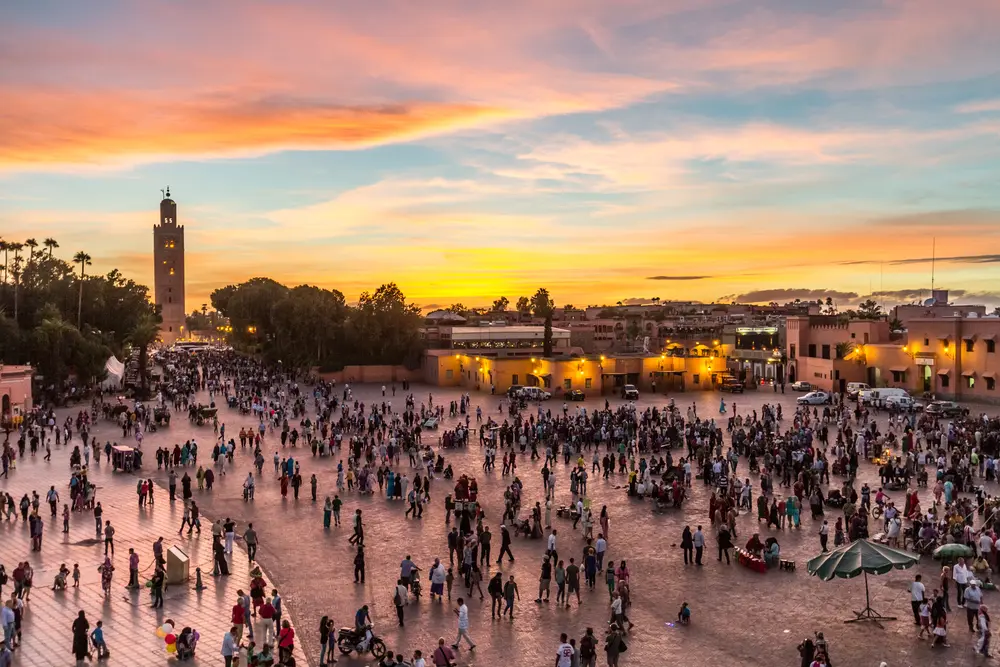
In tourist hotspots like Marrakech's Jemaa el-Fnaa square, street performers (snake charmers, water sellers in traditional guerab dress, monkey handlers) expect an immediate payment of 20 to 50 MAD if you take their photo.
Photographing military installations, police checkpoints, government buildings, and border crossings is strictly illegal in Morocco.
5. DO respect mosque access restrictions and shoe etiquette
Non-Muslims are legally prohibited from entering active mosques across Morocco. The single major exception is the Hassan II Mosque in Casablanca, which offers paid guided tours inside non-prayer hours.
You can photograph mosque exteriors and open courtyard doorways from the outside, but remain quiet and respectful near entrances during the five daily prayer times.
If invited into a private home or entering a traditional Hammam (bathhouse) changing zone, always remove your shoes at the door unless your host explicitly tells you to keep them on.
6. DON'T consume food, drinks, or smoke publicly during Ramadan daytime
During the holy month of Ramadan, Muslims fast (Siam) from dawn (Fajr) until sunset (Maghrib). Eating, drinking water, chewing gum, or smoking in public during daylight hours is culturally insensitive.
Tourists are not required to fast. However, consume your daytime meals, coffee, and water inside your hotel, riad, or within closed indoor sections of tourist-facing restaurants.
Be patient during the hour leading up to Iftar (the evening meal to break the fast), as traffic becomes congested and service temporarily pauses while families gather to eat.
7. DO agree on taxi fares or insist on the meter before stepping in
When taking a city Petit Taxi, ensure the driver turns on the meter (le compteur) as soon as you start the trip. If the driver claims the meter is broken, negotiate and lock in the fare before getting into the vehicle.
For regional Grand Taxis (which run on fixed shared routes), clarify whether you are purchasing a single seat (place) or paying for the entire taxi (course).
Keep small bills (10 and 20 MAD notes) handy to pay exact fares, as drivers rarely have change for 100 or 200 MAD bills.
8. DON'T treat every shop conversation as a commitment to buy
Moroccan merchants excel at conversation and hospitality, frequently offering mint tea while showing carpets, leather goods, or ceramics. Enjoying tea and chatting does not legally or morally obligate you to buy.
If you are not interested in buying, politely decline early. However, if you enter into a price negotiation in a souk and the seller agrees to your counter-offer, it is expected that you complete the purchase.
Haggling is standard practice in open-air souks, but avoid bargaining in modern supermarkets, pharmacies, fixed-price shops (prix fixe), or restaurants.
9. DO tip service staff, porters, and parking guardians
Tipping (backsheesh) is a customary part of everyday life and low-wage income in Morocco.
Tip 5 to 10 MAD at casual local cafés, 10% of the bill at sit-down restaurants, 10 to 20 MAD for medina luggage porters pushing handcarts, and 3 to 5 MAD to high-vis street parking attendants (Gardiens de Voiture).
Keep a dedicated pocket with small coins and 10 MAD notes so you can tip smoothly without opening your main wallet.
10. DON'T rush, embrace 'Inshallah' and the local pace
Time and scheduling operate on a more relaxed, flexible rhythm in Morocco. You will frequently hear the phrase 'Inshallah' (God willing) when discussing future plans, arrival times, or service delivery.
Overbooking your daily itinerary creates unnecessary anxiety when train arrivals, restaurant service, or souk walks take longer than expected.
Build 30 to 60-minute buffers between activities, slow down to enjoy mint tea breaks, and adapt to the local pace.
11. DO know that unmarried couples can generally share a hotel room
This is a common source of anxiety for first-time visitors, but most hotels and riads that host international travelers do not require proof of marriage to book a double room.
As long as you behave respectfully in public, this is rarely an issue in tourist-facing accommodation in major cities. It's a different story with strictly local, family-run guesthouses in more conservative areas, where it's worth booking two rooms if you're unsure.
12. DON'T show public displays of affection or drink alcohol outside licensed venues
Morocco has conservative norms around public affection, keep kissing, hugging, and intimate gestures for private settings. Hand-holding is generally tolerated for tourist couples but is best kept discreet outside modern city districts and resort areas.
Alcohol is legal but only sold and consumed in licensed hotel bars, lounges, and select restaurants. Drinking in public spaces or outside a licensed venue is both culturally inappropriate and against local regulations, avoid public intoxication entirely.
Frequently asked questions
Do women need to cover their hair in Morocco?
No, covering your hair is not required for tourists, even at religious sites open to non-Muslims. Carrying a lightweight scarf is still useful if you want extra modesty or for photos.
Can unmarried couples share a hotel room in Morocco?
Yes, generally. Most hotels and riads that host international travelers don't require proof of marriage. It can be different at strictly local, family-run guesthouses in more conservative areas, where booking two rooms is a safer bet if unsure.
Can you drink alcohol in Morocco?
Yes, but only in licensed venues like hotel bars, lounges, and select restaurants. Drinking in public spaces or outside a licensed venue is culturally inappropriate and against local regulations.
Is it okay to hold hands or show affection in public in Morocco?
Hand-holding is generally tolerated for tourist couples, especially in modern city districts and resort areas, but kissing, hugging, and other intimate gestures should be kept to private settings.
What should you never do in Morocco?
Avoid eating communal food with your left hand, photographing people without permission, entering active mosques as a non-Muslim (except the Hassan II Mosque in Casablanca), and consuming food or drink publicly during Ramadan daylight hours.
Travel tip
Carry a small pouch with 5, 10, and 20 MAD coins and bills separate from your main wallet for easy tipping, taxi rides, and small purchases.
Travel with curiosity and mutual respect
Navigating etiquette in Morocco comes down to observational awareness and simple social respect. Greeting locals in Darija, keeping small cash ready, and respecting local dining and religious customs will instantly set a positive tone for your trip.
Approach unexpected delays or cultural differences with patience, giving yourself room to adapt will make your Moroccan journey far more memorable and rewarding.
Found this useful?
Share it with someone planning a trip to Morocco.
Continue planning
Explore more Morocco travel information
Check prices, explore Moroccan destinations, or estimate your total trip budget.
Browse Morocco Prices
See what travelers typically pay for everyday goods and services.
Explore prices →Explore Moroccan Cities
Discover destinations, local areas, attractions, and practical tips.
Explore cities →Calculate Your Morocco Budget
Estimate accommodation, food, transport, activities, and more.
Calculate your budget →