
Morocco SIM Card Guide 2026: Prices, Where to Buy & Best Network
SIM cards from 20–30 MAD, data from 10 MAD/GB. Compare Maroc Telecom, Orange & Inwi coverage, passport rules, and the '*3' top-up trick tourists miss.
A local SIM card in Morocco typically costs 20–30 MAD (~$2–$3), with data priced around 10 MAD (~$1) per GB — a 10GB bundle runs about 100 MAD (~$10).
Staying connected while traveling in Morocco is straightforward and affordable, provided you understand local telecommunications regulations and network coverage dynamics.
While international roaming or portable Wi-Fi units exist, buying a local physical SIM card or installing an eSIM is by far the most cost-effective solution for reliable mobile data.
This guide breaks down network coverage across Morocco's top providers, mandatory passport registration laws, airport vs. city shop buying strategies, and the critical recharge code trick required to activate data.
Maroc Telecom vs Orange vs Inwi: which network has the best coverage?
Morocco has three main mobile operators: Maroc Telecom (IAM), Orange Morocco, and Inwi. Choosing the right network depends largely on your itinerary.
Maroc Telecom (IAM) holds the most extensive coverage nationwide. If your travel plans include the Sahara Desert (Merzouga/Zagora), the High Atlas Mountains, or remote road trips, IAM provides the most reliable signal.
Orange Morocco is a close second, offering excellent 4G speed and competitive tourist packages within major cities like Casablanca, Marrakech, Rabat, and Tangier.
Inwi offers budget-friendly rates and solid urban performance, but its coverage drops off faster in rural and mountainous areas.
Do tourists need a passport to buy a SIM card in Morocco?
Yes. Under Moroccan telecommunications laws enforced by the ANRT, every active SIM card must be legally linked to a valid passport or official ID.
If you purchase a SIM card from an official store or airport kiosk, the agent will scan your passport to register the line immediately.
Avoid buying pre-activated SIM cards from informal street vendors without providing your passport. Unregistered SIM cards are flagged by network systems and typically deactivated within 24 to 72 hours.
Where to buy a SIM card: airport kiosks vs. official city stores
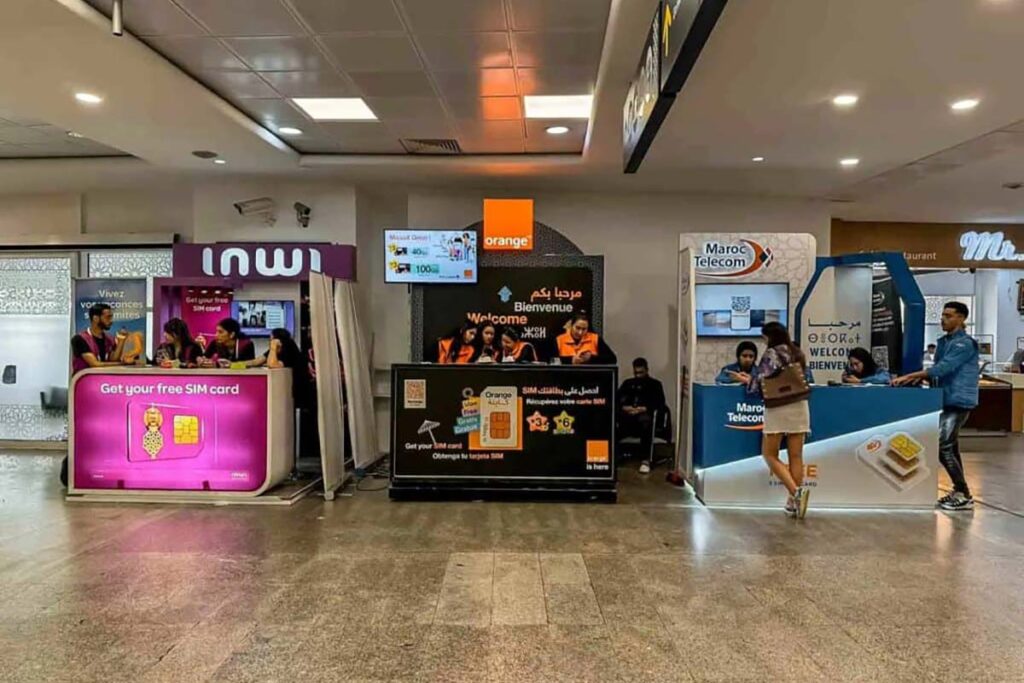
Upon arriving at major international hubs like Marrakech Menara (RAK) or Casablanca Mohammed V (CMN), you will find promotional telecom counters handing out free SIM cards.
While convenient, these free airport SIMs usually contain zero data or minimal promotional balance. You will still need to purchase a data package on-site or at a local shop.
If airport lines are excessively long, wait until you reach the city center and visit an official Maroc Telecom or Orange store for seamless setup and immediate activation.
Physical SIM card vs eSIM: which is better value in Morocco?
eSIMs (from providers like Airalo, Holafly, or Maya Mobile) offer the convenience of installing a data profile before landing without swapping physical cards.
However, local physical SIM cards bought in Morocco provide significantly higher data allowances per dirham compared to international eSIM platforms.
For example, a local SIM typically costs 100 MAD (~$10 USD) for 10GB of data, whereas an international eSIM may charge twice as much for half the data allowance. If you need heavy data usage, a local physical SIM remains the best value.
How to top up data: the essential '*3' code rule
Recharging a prepaid Moroccan SIM is done by purchasing physical scratch cards or digital top-ups at 'Hanouts' (corner grocery stores) found on almost every street.
When entering the scratch card pin code on your phone, you MUST append '3' to the end of the digit string (e.g., 12012345678901233# depending on the provider format).
Appending '3' instructs the network to convert your credit directly into internet data. Failing to include '3' will convert your purchase into voice call credit, which rapidly consumes your balance.
Critical Top-Up Rule
Always tell the shopkeeper you want 'Recharge Internet' or append '*3' to your top-up code. Standard top-ups default to phone calls and will not grant you a data bundle.
How much does a SIM card cost in Morocco?
Mobile data in Morocco is standard and budget-friendly across all major networks:
Base SIM Card: Free at airports, or 20 to 30 MAD (~$2–$3 USD) at city shops.
Data Rate: Standard pricing is 10 MAD (~$1 USD) per 1GB of data, valid for 7 to 14 days depending on the package tier.
- 50 MAD (~$5 USD) = 5GB data bundle
- 100 MAD (~$10 USD) = 10GB data bundle
- 200 MAD (~$20 USD) = 20GB data bundle
Frequently asked questions
How much does a SIM card cost in Morocco?
A base SIM card costs 20–30 MAD (~$2–$3 USD) at an official city shop, or is sometimes given free at airport kiosks with no data loaded. Data runs about 10 MAD (~$1 USD) per GB, so a 10GB bundle costs roughly 100 MAD (~$10 USD).
Do tourists need a passport to buy a SIM card in Morocco?
Yes. Moroccan law requires every SIM card to be registered to a valid passport or official ID at the point of sale. SIM cards sold without this registration are typically deactivated within 24–72 hours.
Which network has the best coverage in Morocco?
Maroc Telecom (IAM) has the widest coverage, including remote areas like the Sahara Desert and High Atlas Mountains. Orange Morocco offers strong 4G speeds in major cities, while Inwi is budget-friendly but has weaker rural coverage.
Is a physical SIM card or an eSIM better for Morocco?
A local physical SIM card generally offers significantly more data per dirham than international eSIM providers like Airalo or Holafly. eSIMs are more convenient for short trips, but a local SIM is the better-value option for heavy data use.
How do I add data credit to a Moroccan SIM card?
Buy a top-up scratch card or digital recharge at any local grocery store (hanout), then enter the code followed by '*3'. This tells the network to apply the credit as data instead of voice call minutes.
Can I buy a Morocco SIM card at the airport?
Yes, most major airports like Marrakech Menara and Casablanca Mohammed V have telecom kiosks offering free or low-cost SIM cards. These usually come with little or no data pre-loaded, so you'll still need to buy a data package on the spot or at a city shop.
Pro Traveler Strategy
If visiting the Sahara Desert or hiking in the Atlas Mountains, get a Maroc Telecom (IAM) SIM. Always test your data connection and check your remaining balance by dialing the operator menu before leaving the store.
Stay connected smoothly across Morocco
Getting high-speed data in Morocco is simple when you register your SIM with your passport, choose the right operator for your itinerary, and use the '*3' shortcut when recharging.
By following these steps, you will enjoy reliable connectivity from urban medinas to desert dunes without unexpected deactivations or inflated roaming fees.
Found this useful?
Share it with someone planning a trip to Morocco.
Continue planning
Explore more Morocco travel information
Check prices, explore Moroccan destinations, or estimate your total trip budget.
Browse Morocco Prices
See what travelers typically pay for everyday goods and services.
Explore prices →Explore Moroccan Cities
Discover destinations, local areas, attractions, and practical tips.
Explore cities →Calculate Your Morocco Budget
Estimate accommodation, food, transport, activities, and more.
Calculate your budget →